
We have spent recent months on planes, in boardrooms and on the ground, leaving our field notes slightly behind our travel schedule. To catch up, we're sharing a five-part series of fresh, unfiltered observations directly from our company meetings, skipping the textbook macro forecasts to focus on ground-level operational realities.
Catch up on the series: Part 1 – Egypt | Part 2 – Latin America, from New York | Part 3 – Philippines
From here on out, our rule is simple: we travel, we meet management, and we publish while the insights are still fresh.
In Thailand, we expected the Middle East war, higher energy prices and weak domestic demand to dominate every conversation. The surprise was how many companies were already looking through the shock.
The fourth part of our recap of our travels during the first half of the year takes us to Bangkok.
By the time we arrived in April, the macro backdrop looked uncomfortable. The war in the Middle East had pushed energy security to the front of investors' minds. The country imports a significant share of its oil consumption and has been a net importer of natural gas for years, which makes global oil and liquefied natural gas (LNG) prices more than just a headline risk. They feed into transport costs, electricity bills, margins and, eventually, consumer spending.
On paper, this looked like the kind of environment where corporate confidence should be low. Thailand already had plenty to worry about before the external shock: a cautious middle-class consumer, uneven tourism, pressure on household purchasing power, and a political system that has often struggled to deliver stable government.
So we arrived with a fairly defensive assumption. We expected management teams to be cautious, perhaps even downbeat.
That was not what we found.
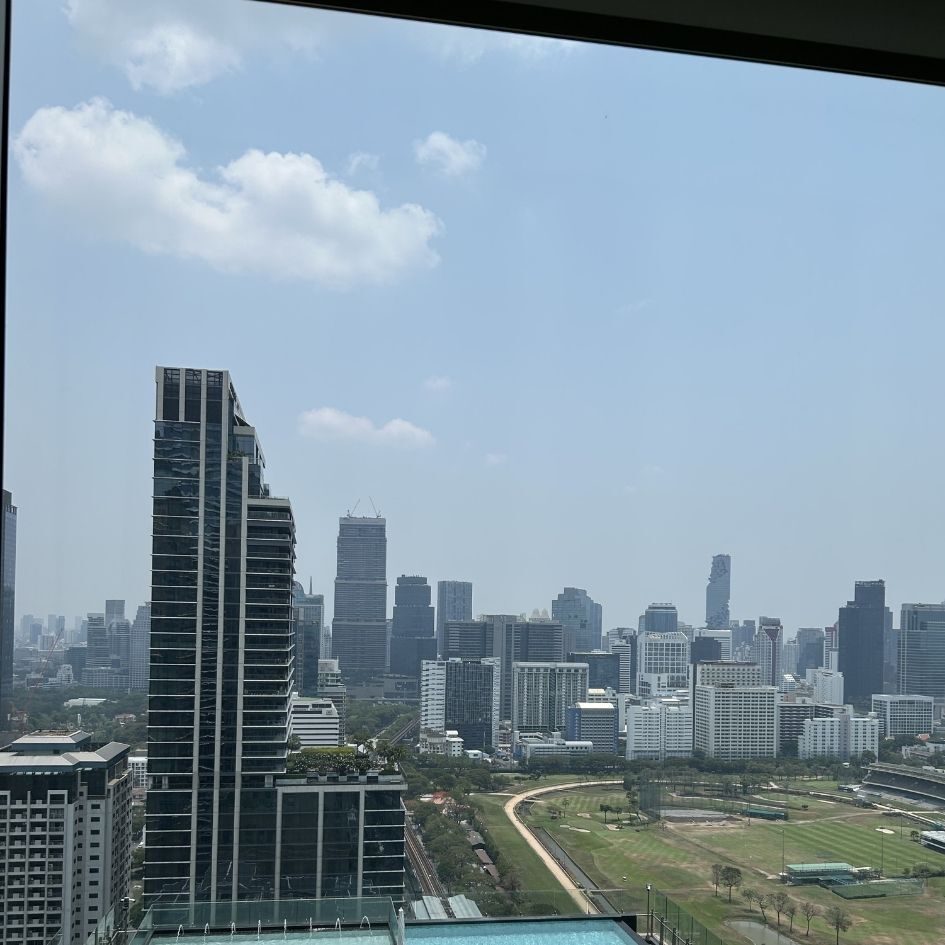
View over Bangkok.
The tone in Bangkok was not euphoric. Companies were clear about the risks. Hotels and hospitals had seen softer Middle Eastern demand. Freight costs had risen. Beverage exporters were dealing with dearer inputs and disrupted shipping. Lenders were watching diesel and fertiliser costs feed into farmer behaviour. Domestic mid-tier consumption remained soft.
But the dominant message was that the shock was contained, not structural. Many companies saw the war as a second-quarter disruption rather than a permanent break in demand. Several pointed to pent-up travel, delayed rather than cancelled capex, and consumers who are stretched but still spending selectively. Management teams were also surprisingly constructive on the political backdrop under Thailand's Prime Minister Anutin Charnvirakul, whose position has been confirmed by the Royal Thai Government and who remained in office after a March parliamentary vote.
That is crucial for Thailand. Investors have become used to political interruptions. A government that can simply last long enough to execute policy is not a small thing.
Our main takeaway was that Thailand is not a market where everything is suddenly fixed. It is a market where the companies worth owning are not waiting for everything to be fixed. They are adapting around soft demand, using scale, data, distribution and balance sheets to widen the gap to weaker competitors.
In Latin America, complexity was the moat. In Egypt, crisis was the filter. In the Philippines, the theme was discounted resilience.
In Thailand, the theme is contained shock and local compounding.
The shock was real, but not everything changed
The Middle East war appeared in many conversations, but its effects varied by sector. For tourism-exposed businesses, the impact was visible in softer Middle Eastern hotel occupancy and less predictable medical tourism flows. For exporters, the main challenge was shipping, with higher freight costs and more complicated trade routes. Osotspa, the beverage and personal-care company behind brands such as M-150 and Lipo, described Middle East expansion as paused rather than abandoned.
For lenders, the channel was the consumer. Muangthai Capital, Thailand's market leader in vehicle and land title lending, saw loan demand soften as customers became more cautious in response to higher diesel and fertiliser prices. Importantly, this appeared to reflect hesitation rather than a broader deterioration in demand.
That distinction came up repeatedly. Companies were not dismissing the shock, but managing it through pricing adjustments, selective investment and balance-sheet discipline. What we did not hear was panic. Many of Thailand's stronger companies benefit from multiple growth levers, including pricing, distribution, recurring revenues and regional exposure, helping them navigate periods of uncertainty more effectively.
Politics: cautious optimism around Anutin
Thailand's political history has taught investors to be sceptical. Stable government has often been the exception rather than the norm, making policy continuity difficult to underwrite and weighing on private-sector confidence.
That is why the tone around Prime Minister Anutin Charnvirakul stood out. The management teams we met were not making bold political forecasts, but many were more optimistic than we expected. The argument was practical: if the government can remain in place, maintain targeted consumer support and keep industrial policy moving, the private sector has enough underlying momentum to respond.
The lesson was not that politics no longer matters. It was the opposite. In a market where domestic demand is soft but not broken, a steadier political backdrop can have an outsized effect on confidence, investment and sentiment.
Industrial estates: data centers change the map
One of the strongest structural themes in Bangkok was the rise of data centers. WHA Corporation, Thailand's leading industrial-estate developer, sits in the middle of that story. As demand shifts, data-center customers are becoming particularly important because they consume far more water and power than traditional industrial tenants, strengthening WHA's recurring utility revenue base.
That shift matters because it turns industrial land development into a broader infrastructure ecosystem. While land sales can be lumpy, recurring revenues from utilities, power and services are more durable. WHA is not simply selling plots, but building the infrastructure around them.
The theme also highlights Thailand's competitive position. While the country may not always be the lowest-cost manufacturing location, it remains attractive for industries that require reliable infrastructure, logistics and supplier networks, including semiconductors, Taiwanese foreign direct investment and battery manufacturing. The key bottleneck is power infrastructure, with grid capacity and related approvals determining how quickly new projects can move forward.
Value retail: the consumer is cautious, but value is winning
One of the clearest messages from our meetings was that Thai domestic demand is softest in the middle. While premium consumers have remained relatively resilient and lower-income households can benefit from government support, middle-class consumers are increasingly cautious and sensitive to price. That creates a challenging environment for many companies, but an attractive one for the best value retailers.
Mr D.I.Y. Holdings Thailand is a good example. The company has built a national home-improvement and general merchandise format around a simple proposition: broad assortment, low prices and strong execution. With further store expansion ahead and investments in automated logistics, it continues to benefit from consumers' focus on value.
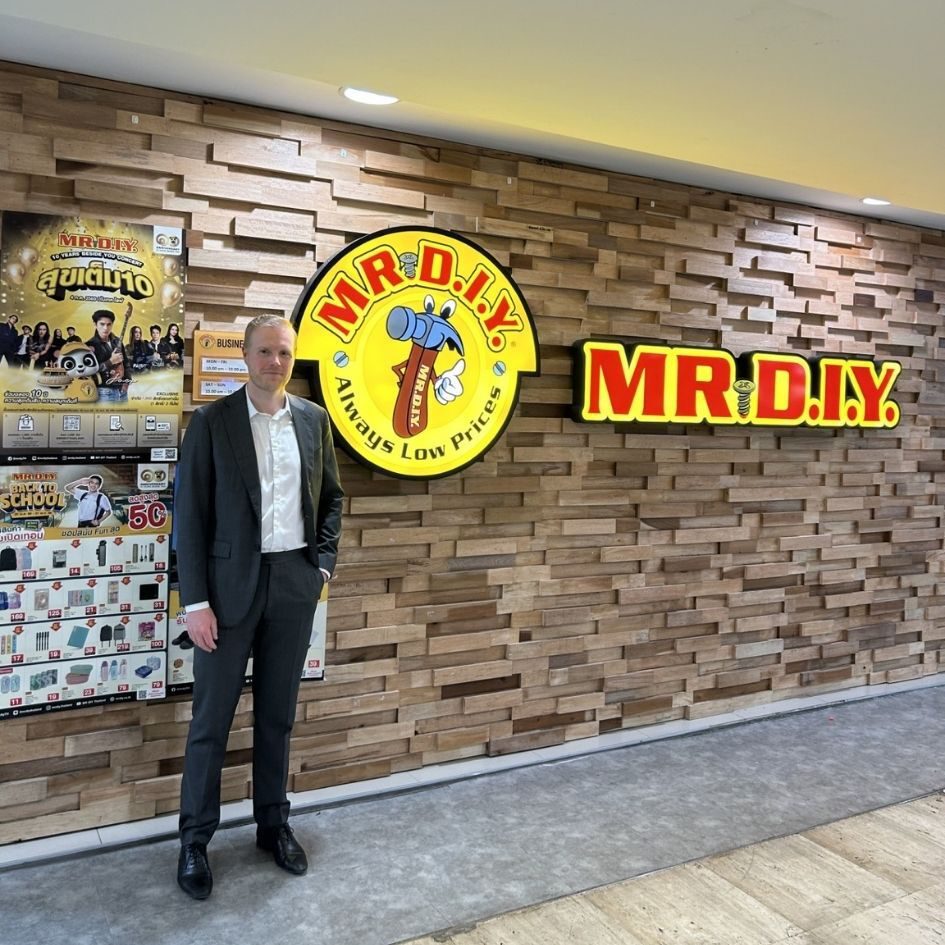
Senior Portfolio Manager Antti Sivonen visiting Mr D.I.Y.
Moshi Moshi, the lifestyle value retailer, fits a similar pattern in a different category. The company combines strong margins and fast product turnover with a sharp eye for trends from Japan, Korea and Singapore. More broadly, the lesson was that weak sentiment does not affect all retailers equally. In a cautious consumer environment, the winners are often those that make consumers feel smart for spending.
Banks and lenders: relationship still matters
Financial services in Thailand are not only a story about rates. They are also a story about access. Thai Credit Bank focuses on small businesses, micro-enterprises and nano-finance customers that larger banks have often struggled to serve profitably. What stood out was the combination of old and new: relationship-based lending alongside investments in digital infrastructure, with management aiming to build "two banks in one licence" through a scalable digital platform.
Discipline remains crucial. Growth in underbanked segments can look attractive until the first credit cycle reveals whether underwriting was sound. Thai Credit's advantage is that it already knows the customers it wants to serve.
Muangthai Capital, the leader in vehicle and land title lending, illustrates a similar theme. Its extensive branch network, repeat-customer base and funding advantages are difficult for purely digital challengers to replicate. While higher diesel and fertiliser costs have made borrowers more cautious, management still sees a long growth runway. More broadly, the best lenders combine funding depth, branch networks, data and collection discipline, making them more resilient than a simple macro reading might suggest.
Tourism and healthcare: waiting for demand to normalise
Tourism is one of Thailand’s great strengths, but it is also exposed to shocks.
Minor International, with hotels in 66 countries and a regional restaurant business, saw the war's impact most clearly in specific geographies. Europe remained resilient, while the Middle East was of course softer. The important point is that the company's Middle East hotel exposure is largely asset-light, which limits balance-sheet risk.
That asset-light pivot is central to the investment case. Minor is shifting most of its expansion toward management contracts and franchise-like models, while also looking to unlock value through a Singapore-listed real estate investment trust (REIT) and a potential Minor Food listing in Hong Kong. In a volatile environment, asset-light growth and “de-conglomeration” are powerful tools.
The company was also disciplined on pricing. In Thailand, some competitors were discounting heavily whereas Minor was holding room rates. That is not always easy in the short term, but it protects the brand and avoids training customers to wait for discounts.
Hospitals told a more nuanced story
Bangkok Dusit Medical Services, or BDMS, remains Thailand's hospital blue chip, with 60 hospitals and a strong position in Centers of Excellence. International patients are an important part of revenue, but the company is not only a medical-tourism play. It also serves expats, insured Thai patients and an ageing domestic population.
The war and regional politics affected certain patient flows, including from Cambodia and the Middle East. Thai mid-tier patients were also deferring some elective procedures. But the long-term levers remain intact: higher occupancy, more insurance penetration, Centers of Excellence and a pipeline of new services, including advanced cancer treatment and wellness.
Bangkok Chain Hospital, or BCH, offers a different healthcare exposure. Its model is more value-oriented and tied to Thailand's social-security system. That creates policy sensitivity, but also a large and sticky patient base. The company is expanding in the Eastern Economic Corridor, where hospital capacity is lower than in Bangkok and incentives for medical infrastructure are attractive.
Healthcare in Thailand is not immune to geopolitics or consumer pressure. But the structural drivers, ageing, insurance growth, regional patient flows and under-bedded areas, remain strong.
Telecoms: the merger starts to show
True Corporation is an interesting self-help story in Thailand. The merger between True and DTAC created a larger mobile operator, but early concerns centered on balance-sheet pressure and execution risk. By the time of our meetings, network modernisation had been completed, synergies were ahead of the original target and the company had returned to profitability.
The investment case now rests on a cleaner runway: modest revenue growth, rising EBITDA (earnings before interest, taxes, depreciation and amortisation) margins, lower capital expenditure and falling debt. Management also sees scope for the valuation discount to competitors to narrow as deleveraging continues.
In a low-growth market, the opportunity is not rapid subscriber growth but operational improvement through efficiency gains, pricing discipline, spectrum benefits and debt reduction. In other words, the equity story is not about the market becoming more exciting, but about the company becoming simpler.
Electronics and energy: AI appears in unexpected places
The artificial intelligence theme in Thailand showed up in two very different companies. Hana Microelectronics is recovering from a cyclical downturn, but the more interesting opportunity lies in AI-related cooling solutions. The potential upside is significant, but so is the risk: customer concentration is meaningful, and the company is funding the required investment itself.
BCPG, the clean-energy company, offers another route into the theme. Its US natural-gas plants are located near areas experiencing strong data-center power demand, while the company also owns renewable and hydro assets across Thailand, Laos, Vietnam, Taiwan and Japan.
The broader point is that AI is not only a software theme. It is also a cooling, power and infrastructure theme. In Thailand, we saw its influence extending across electronics, energy infrastructure and industrial development.
Consumer staples and defensive growth
Not every company needs a strong macroeconomic cycle to grow. Osotspa is a case in point. Despite higher input costs, the company continues to benefit from strong brands, high margins and a focus on profitability, with premium products growing faster than entry-level offerings.
International growth has been more challenging, with Myanmar affected by import-licence rules and Middle East expansion delayed by higher freight costs and regional uncertainty. Even so, the underlying business remains highly profitable and management remains disciplined in its capital allocation.
Mega Lifesciences offers another example of defensive growth. The company sells branded pharmaceuticals and nutraceuticals across frontier and emerging markets, with opportunities ranging from improving conditions in Myanmar to ambitions in Indonesia and the planned launch of a GLP-1 obesity pill in Thailand in early 2027. The broader lesson is that these businesses rely less on improving consumer sentiment and more on repeat demand, trusted brands and disciplined execution.
The risks are still there
Thailand's challenges are not difficult to identify. Energy import dependence makes global shocks painful. A higher oil price can squeeze the consumer and raise costs across the economy. Domestic demand is still soft in the mid-tier. Tourism is exposed to geopolitics. Hospitals and hotels depend on international patient and visitor flows that can change quickly. Industrial-estate growth depends on power infrastructure moving fast enough. Political stability remains an assumption, not a permanent fact.
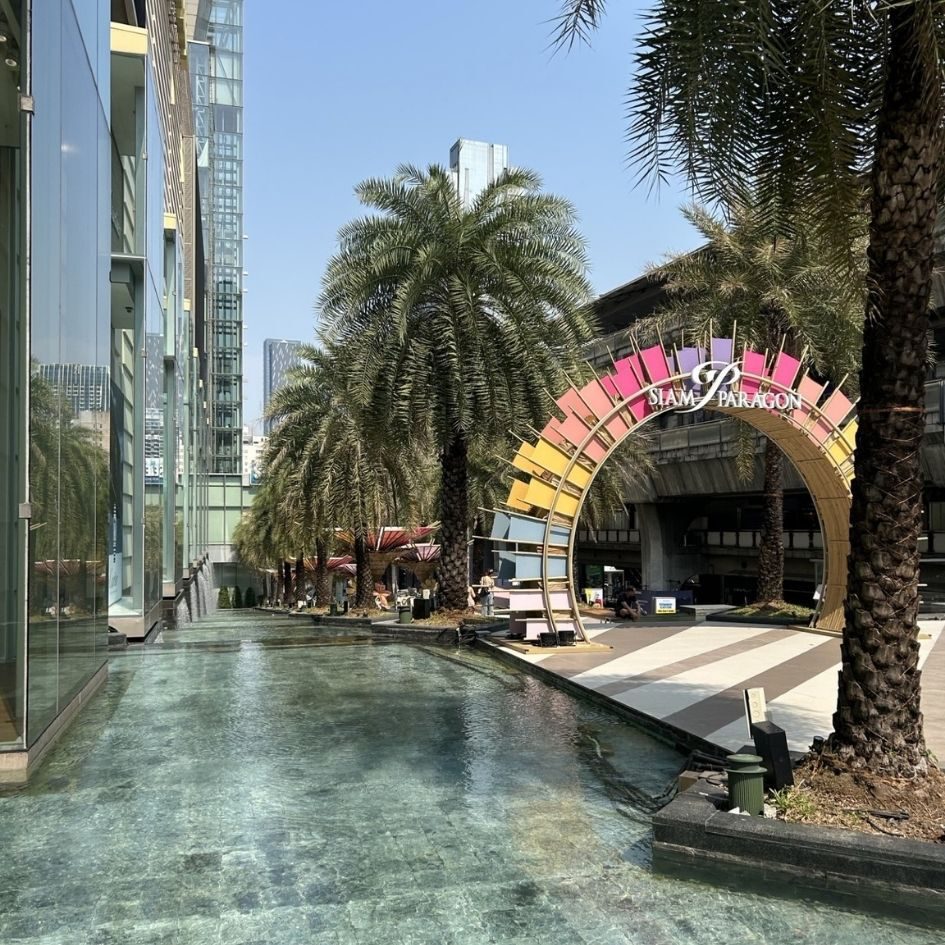
Street view in Bangkok.
There is also a risk that investors overstate the data center and AI themes. Demand is real, but infrastructure cycles can attract too much capital if everyone underwrites the same growth curve. Power availability, grid approvals, customer concentration, and capex discipline will matter. But the companies we met were not ignoring these risks. They were working around them.
WHA is turning land into a utility and infrastructure ecosystem. Mr D.I.Y. and Moshi Moshi are taking share from cautious consumers by offering value. Thai Credit and Muangthai are using relationships and data to serve customers larger banks often overlook. Minor is becoming more asset-light. BDMS and BCH are leaning on structural healthcare demand. True is executing a post-merger turnaround. Hana and BCPG are finding AI exposure in manufacturing and power. Osotspa and Mega are using brands and distribution to compound through noise.
That is a very different picture from a market simply waiting for macro relief.
The takeaway
Thailand surprised us. We expected energy anxiety, weak consumer sentiment and political uncertainty to dominate the trip. Those issues were present, but they were not the whole story. The companies we met were more optimistic, more focused and more self-directed than the macro headlines suggested.
The Middle East war was being treated as a shock to manage, not a reason to stop investing. Tariffs had frozen some decisions, but once the new reality became clearer, decisions began to restart. Domestic demand was soft, but not absent. Political stability was not guaranteed, but the tone around the current government was more constructive than we expected.
For investors, that is the interesting setup. Thailand is not obviously cheap because everything is easy but it is interesting because a difficult environment is separating companies that rely on the cycle from companies that can compound through it.
This brings us back to the thread running through the series.
In Latin America, we saw how complexity can become a moat. In Egypt, we saw how crisis can act as a filter. In the Philippines, we saw resilience being discounted by the market. In Thailand, we saw something slightly different: an external shock that looked severe from the outside, but that strong local operators were already absorbing, adapting to and, in some cases, using to strengthen their positions.
That is why these trips matter. Computer screens and Excel sheets show multiples, margins and growth rates. They rarely show whether a management team is afraid, complacent or quietly confident. In Bangkok, the mood was not without concern. But it was much better than we expected.
And in markets, that gap between expectation and reality is where alpha lies.
References to individual companies are for illustrative purposes and do not constitute investment recommendations.
The contents of this blog should not be considered as investment advice and should not be relied upon in making an investment decision. Before making an investment decision, you should consult the fund's legal documents, such as the fund rules, the key investor document and the fund prospectus. The statutory documents and additional information of the funds are available on the product-specific pages and on www.evli.com/funds.
Historical returns are no guarantee of future returns. The value of an investment may rise and fall, and the investor may lose some or all of the capital invested. The fund’s investment activities are aimed at maximizing the increase in the value of assets. As the fund’s return expectation and risk level are high, we recommend the fund to experienced investors with long investment horizons. All the fund’s assets are invested in emerging economies’ equity markets, which means that the fund’s value may fluctuate abruptly within a short period as a result of the general performance of the target markets and exchange rate fluctuations. More information on risks is available in the fund prospectus.
Alongside the authors, the analysts from the Evli Emerging and Frontier Markets Team also contributed to the writing of this blog.


