US economy remains resilient, while Europe loses momentum
The US economy has continued to outperform Europe, supported by robust consumer spending and strong investment. The economy expanded by a stronger-than-expected annualised 3.4% in the third quarter. In September, the personal consumption expenditures (PCE) price index accelerated to 3.6%, while core PCE inflation stood at 3.1%. Higher energy prices added to inflationary pressures. Strong demand and the low level of initial jobless claims point to continued economic resilience, although persistent inflation is making it more difficult to ease monetary policy.
Growth in the euro area remains subdued, with higher energy prices, rising interest rates and political uncertainty weighing on the outlook. Leading indicators are sending mixed signals: industrial investment is supporting growth, while declining new orders and a modest weakening in labour market conditions are increasing the risk of a slowdown.
The conflict in the Middle East and the risk of supply disruptions in the Strait of Hormuz kept oil prices and transportation costs elevated. Trade tensions also continued to fuel uncertainty.
A divided government following the US midterm elections is largely priced into markets, but an outcome that differs from expectations could alter the outlook for fiscal policy. In Europe, investors have been particularly concerned about France's fiscal deficit, rising debt and political uncertainty.
AI concerns challenge the equity market rally
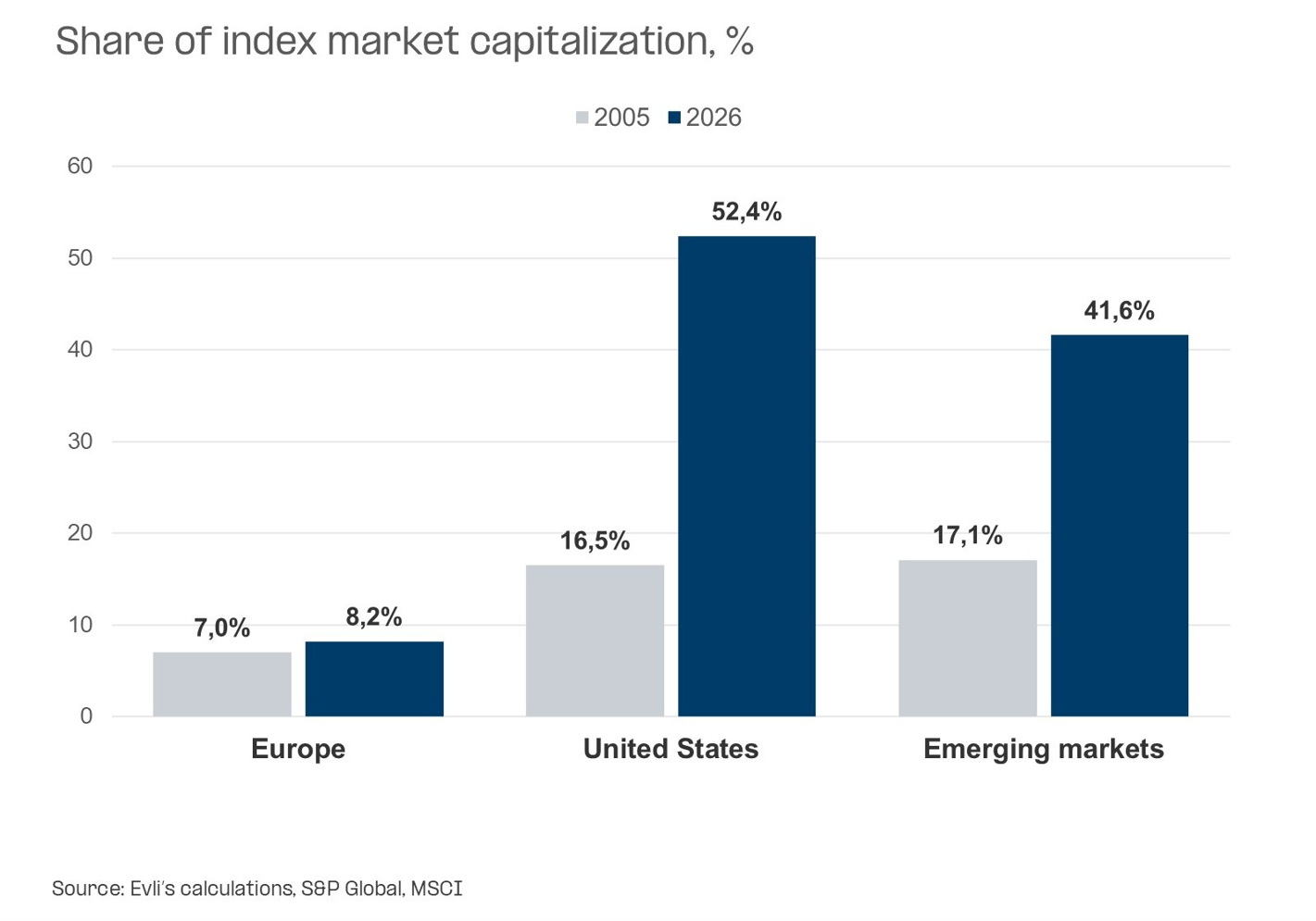
The recent decline in risk appetite has weighed particularly on the technology sector and emerging markets. Market concentration and the growing dependence on AI-related investment have increased sensitivity to negative surprises. Higher financing costs or cuts to investment spending could weaken companies' growth prospects. The rotation away from large technology companies towards other sectors also partly reflects an unwinding of previously crowded overweight positions.
As the earnings season gets under way, attention has centred on the returns generated by hyperscalers' investment spending and demand for cloud services. Even solid results have not necessarily been enough to trigger positive share-price reactions. Intel lowered its guidance for the remainder of the year, despite adjusted quarterly earnings exceeding expectations. Amazon's revenue and earnings fell short of expectations. Weakness in e-commerce and advertising, combined with massive AI-related investment, weighed on cash flow. Alphabet's advertising growth slowed in the search segment and missed expectations, adding to concerns about the impact of AI on the earnings power of its search business. At the same time, heavy investment pushed quarterly free cash flow to negative USD 9 billion. Strong growth in cloud services was not enough to offset these disappointments.
Nevertheless, the baseline outlook for equity markets remains positive for the remainder of the year. In the US, earnings for S&P 500 companies are expected to grow by 30% in the fourth quarter, and in Europe, earnings for Stoxx 600 companies are forecast to increase by 39%. Earnings growth is expected to moderate next year but remain positive. The analyst consensus currently points to earnings growth of around 16% in the US and approximately 10% in Europe.
Interest rate hikes on hold
Returns from fixed-income investments have remained close to zero or turned negative this year. Long-term interest rates have been driven up by inflation, economic growth, and the substantial financing needs of governments and companies.
The yield spread between French and German widened further. France's 10-year government bond yield fluctuated around 5%, while the yield on the German 10-year government bond fell by 0.25 percentage points to 3.33%. Concerns surrounding France have also spilled over into corporate bond markets, although there are no signs of a broader euro-area debt crisis. Risk premiums on high-yield bonds and the debt of companies financing AI infrastructure rose sharply.
The tightening cycle paused in October, with both the Fed and the ECB leaving their key interest rates unchanged. Further interest rate hikes are expected to continue in December and into next year. ECB President Christina Lagarde announced that she will step down from her post early in February 2027. The leading candidates to succeed her are former Dutch central bank president Klaas Knot and Bank for International Settlements (BIS) General Manager Pablo Hernández de Cos.
Figure: Technology's share of the equity market in 2005 and 2026