
The global economy will continue to grow next year, supported by private consumption and investment. Inflation is likely to accelerate early in the year, and central banks will respond by raising policy rates. Equity markets may continue to rise, but a weaker outlook for AI investment poses a significant risk. Cyclical companies make up a significant share of the stock market, so strong earnings growth and low valuation multiples can be misleading if the peak of the investment boom is in sight. Other major risks are the war in Iran, which affects inflation and interest rates, and the political situation in France, which could cause problems for European government bonds and the euro.
The global economy is set to keep expanding robustly
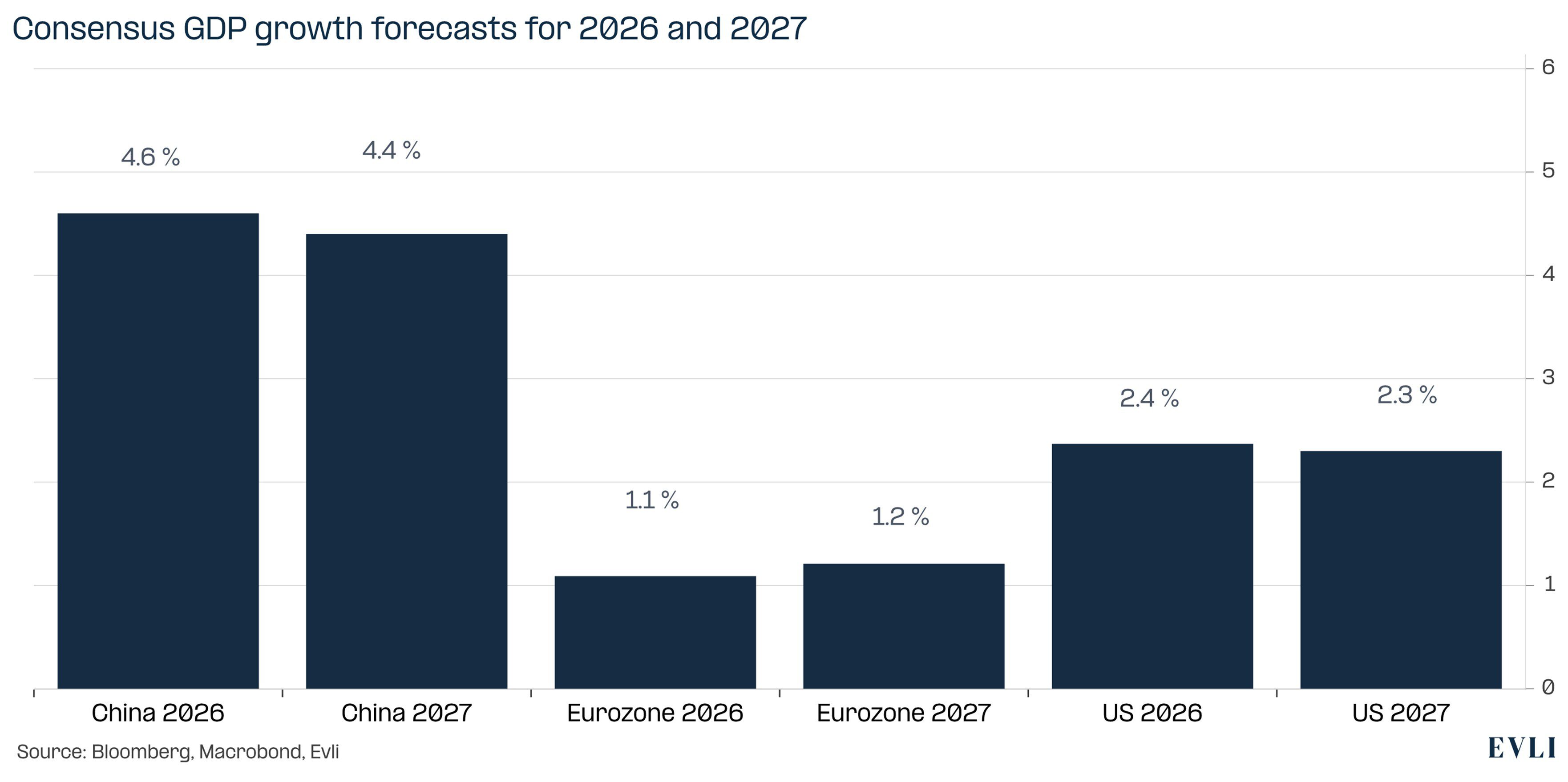
The global economy will grow by around three percent next year, close to its long-term trend. The US economy will grow by just over two percent, the euro area by one percent and China by four percent. Growth will therefore be roughly on par with this year.
Private consumption remains the foundation of US economic growth and makes up most of the economy. Consumption is forecast to grow in line with the economy, as credit card companies and major banks continue to see little sign of consumer stress. Low unemployment supports consumption, whilst inflation weighs on real wage growth. The AI boom, in turn, boosts asset values and supports consumption through wealth effects.
Global industrial activity and investment have returned to growth after a long soft patch. The industrial downturn was driven by overinvestment after the pandemic. China, in particular, wanted to promote industrial self-sufficiency, especially in the semiconductor industry. The AI-driven data centre build-out is boosting industrial and construction activity worldwide.
Figure 1: Economists expect growth to continue for the rest of this year and next.
Central banks set to raise policy rates as inflation accelerates
Inflation has picked up late in the year and threatens to accelerate further next year. Economic growth, investment and the war in Iran are adding to price pressures. Although the crude oil market is much better balanced, the situation remains less favourable for jet fuel, diesel and liquefied natural gas.
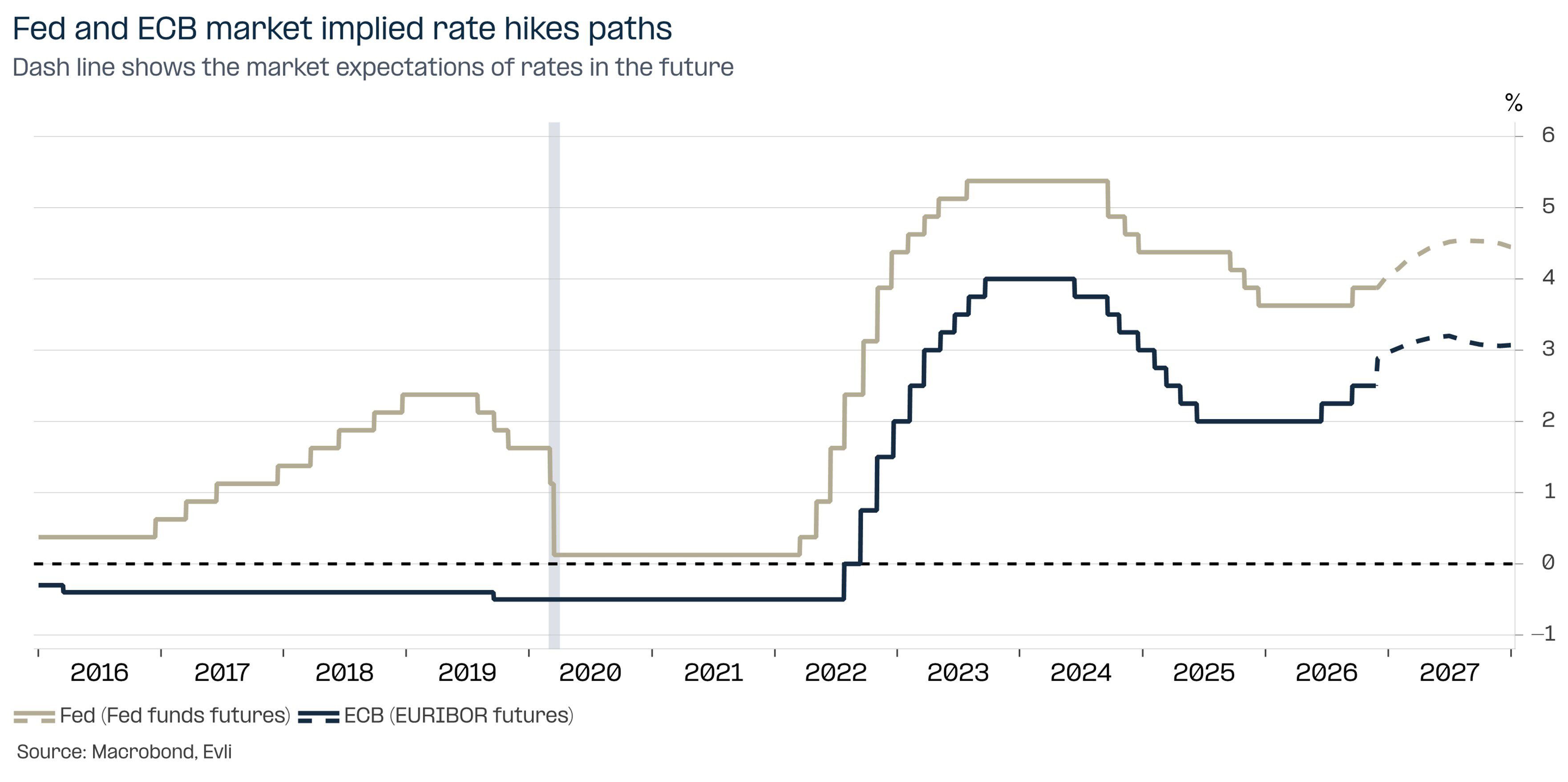
Central banks are responding to higher inflation by raising policy rates. In the United States, economic growth, the war in Iran and AI investment are driving inflation. At the same time, unemployment remains low. The Federal Reserve is very likely to raise policy rates further.
Growth in Europe is not particularly strong, but the war in Iran is pushing up energy prices. In principle, central banks should not react to supply shocks such as war-related inflation. Raising interest rates will not bring additional barrels of oil to the market. If energy price increases persist, they will eventually feed into production costs and wage inflation, as wage bargaining is linked to overall inflation. The European Central Bank (ECB) expects to raise rates as a precautionary measure and intends to cut rates if price increases prove transitory. The ECB wants to avoid repeating the mistakes made during the pandemic, when rate hikes were initiated too late.
Figure 2: Markets expect the Fed to continue cutting rates whilst the ECB remains on hold.
Bonds are back
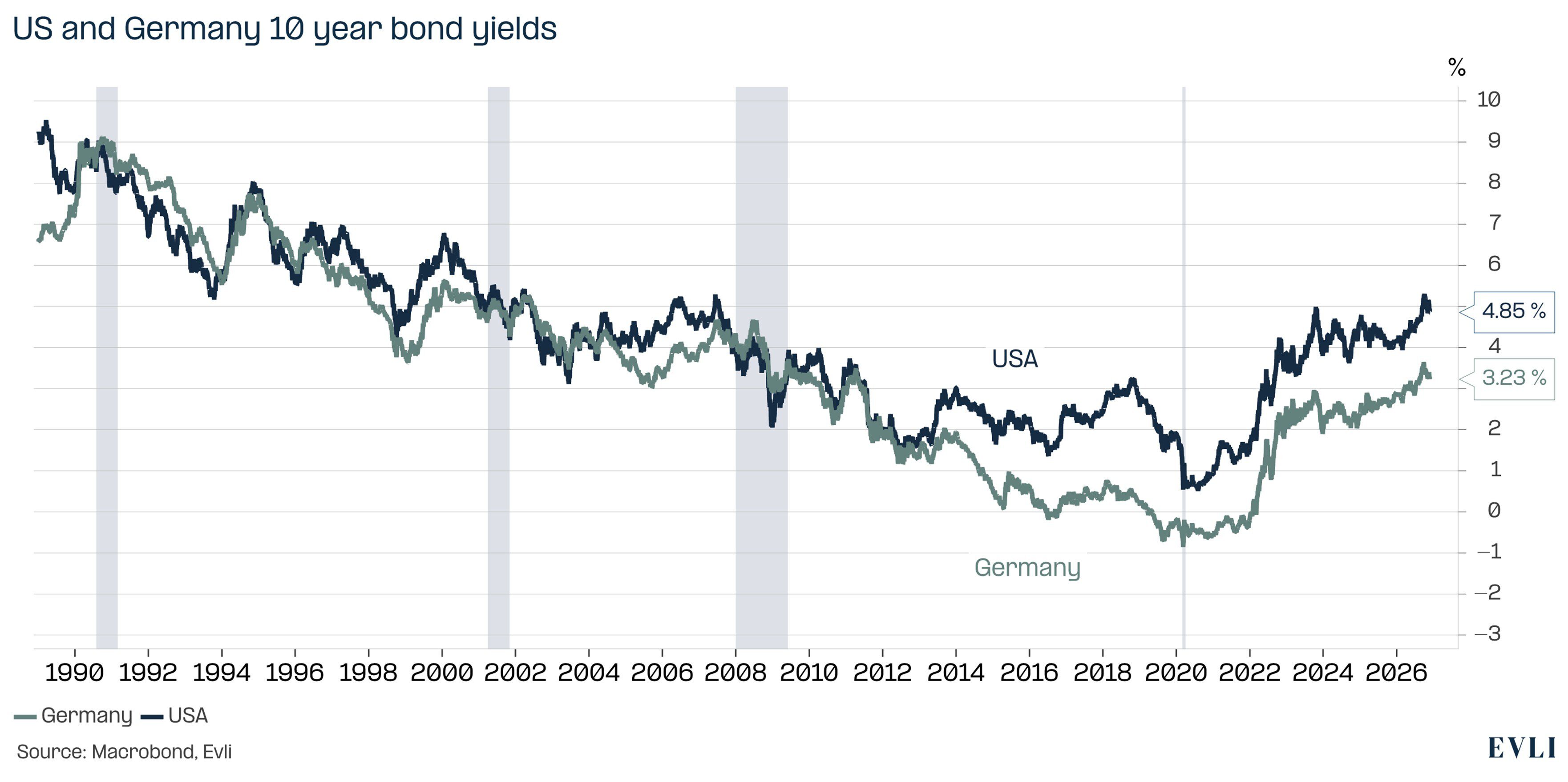
Government bond yields have risen rapidly across developed economies and are likely to remain elevated next year. In the United States, the main drivers of rising bond yields have been economic growth, inflation and AI investment. In Europe, the rise has been particularly sharp in France, where government bond yields have increased significantly relative to Germany’s. Markets fear that France will struggle to service its growing debt burden in the future.
The silver lining to higher interest rates is that bonds once again offer solid returns. US government bond yields have risen to around five percent and European government bond yields to over four percent or five percent. Yields on European high-yield corporate bonds, for example, have risen above seven percent.
The rise in yields is particularly welcome because bonds bring much-needed diversification to equity portfolios laden with AI exposure. They do not protect a portfolio in every situation, however. Bonds provide protection against demand shocks, for example if AI investment stalls. They do not protect against supply shocks, such as an inflation shock caused by an escalation of the war in Iran.
Figure 3: Bond yields have risen significantly, which provides much needed portfolio diversification.
Equity market fundamentals look good but may be misleading
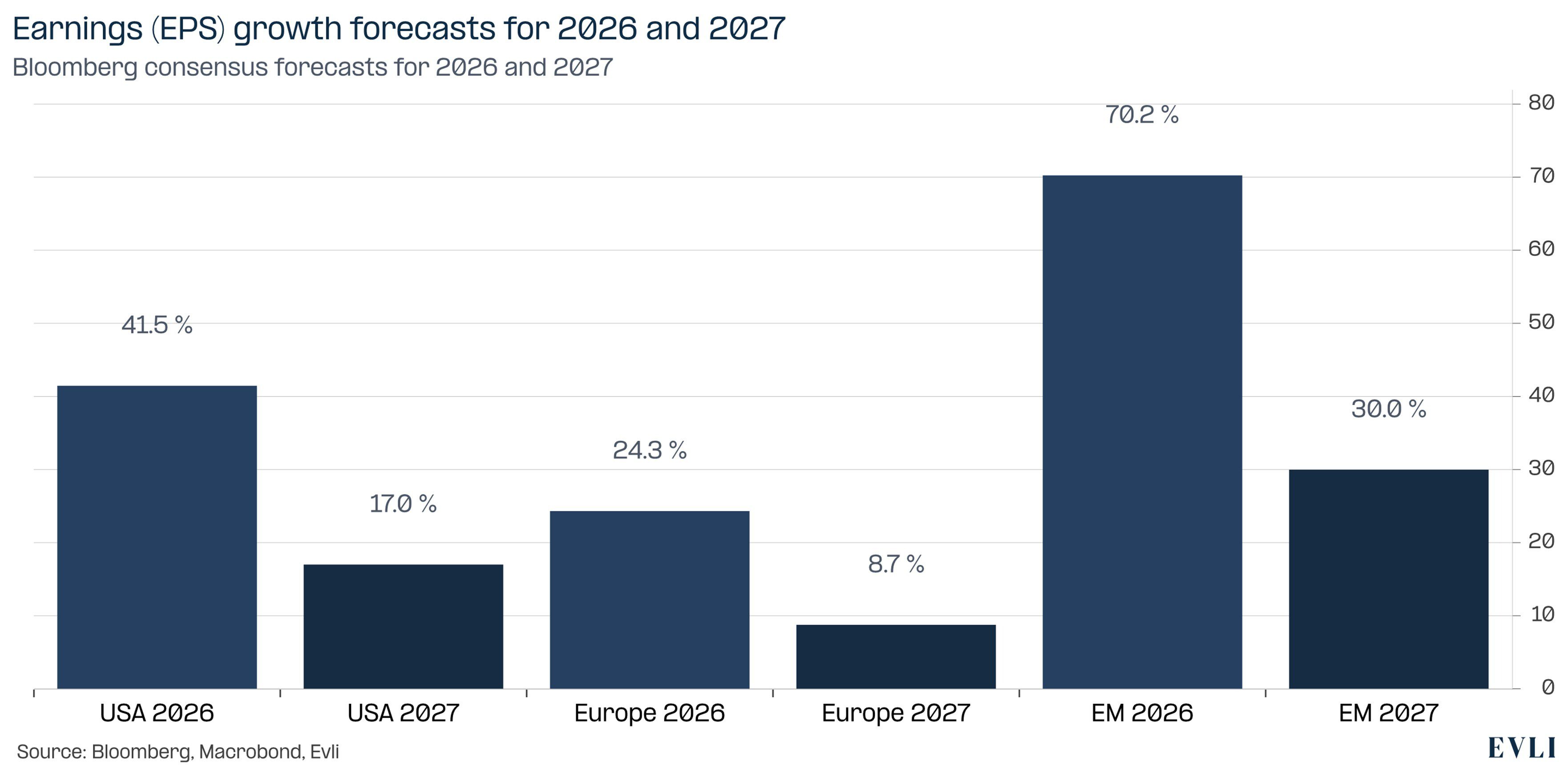
Equity markets have been rising since 2023. US markets have delivered the best returns, but emerging markets and Europe have also performed well. The main driver of equity returns has been strong earnings growth, boosted in particular by the AI construction boom. Earnings have grown exceptionally quickly in 2026. Growth of this magnitude is typically seen only during a recovery from recession.
Earnings growth will slow markedly next year but remain healthy. Companies outside AI will also see their earnings grow. As is the case this year, growth will be fastest in emerging markets, followed by the United States and then Europe. Three semiconductor companies explain the particularly rapid earnings growth in emerging markets: Samsung, SK hynix and TSMC. They produce the bulk of the logic and memory chips used in AI data centres. AI chips, in turn, account for more than half the value of a data centre investment.
The risk of slowing AI investment hangs over the equity rally
Equity markets are likely to keep rising next year unless the outlook for AI investment weakens. The rally is supported by solid economic growth, slowing but still strong earnings growth and reasonable valuations. The problem is that both rapid earnings growth and low valuations may reflect temporarily high profits, which will fall as the AI investment boom cools. The biggest threat to equity markets is therefore the approaching peak in the AI infrastructure build-out. Markets will price this in before the peak becomes apparent.
Cyclical technology companies that benefit from the investment boom make up a significant share of the stock market. Their share prices are closely tied to investment. Cyclical companies look cheap at the top of the cycle because their earnings are temporarily high, keeping valuation multiples low.
Strong earnings come from high prices, which reflect strong demand and limited supply. High prices and margins encourage companies to invest in new capacity. New capacity eventually brings supply and demand into balance and pulls prices and margins lower. Semiconductor companies have started investing record amounts to increase semiconductor supply.
For the most cyclical companies, such as memory chipmakers, lower margins mean shrinking profits. This is why investors are unwilling to give cyclical companies higher valuation multiples.
The rest of the stock market, which is not tied to investment, may benefit for a while as the cycle turns. Investors rotate capital from cyclical technology companies into other sectors such as healthcare and consumer staples. The problem is that these companies are very expensive. US government bonds may offer the best protection against an AI crisis. They have the added advantage of being denominated in dollars. The dollar would benefit from safe-haven flows.
Figure 4: Stockmarket returns in euros since 2023.
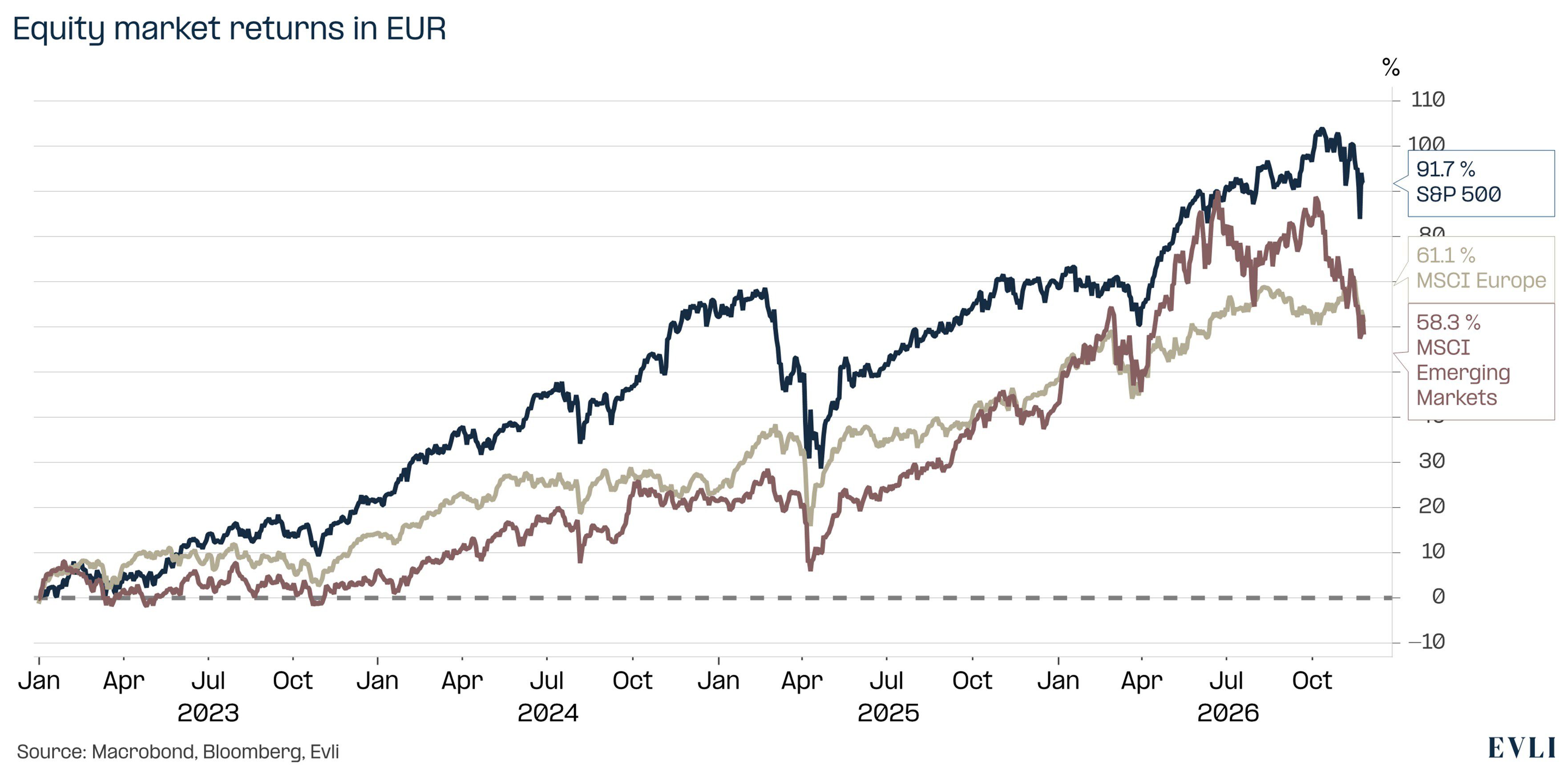
Figure 5: Earnings per share (EPS) growth forecasts for 2026 and 2027.
AI is not the only risk in 2027
Alongside the approaching peak in AI investment, the other major risk next year is the war in Iran. A continuation or escalation of the war in Iran would affect the economy and markets through higher energy prices and interest rates.
Crude oil supply has improved. Saudi Arabia and the United Arab Emirates are using and upgrading alternative export routes, such as oil pipelines. Countries outside the Arabian Peninsula have also increased crude oil production.
The United States has been able to protect oil shipping through the Strait of Hormuz, but this protection raises transport costs. Iran is not exporting oil because of the blockade, which reduces supply. Supplies of refined products such as diesel and of liquefied natural gas have not recovered in the same way as crude oil supply. Further escalation by Iran could jeopardise the improved balance in energy markets.
Can France convince the bond market?
France poses another macro risk next year. Bond markets were not impressed as right-wing populist presidential candidate Marine Le Pen proposed lowering the official retirement age. The French fiscal deficit stands at around five percent of GDP and public debt around 120 percent of GDP. Revenue prospects are weak, as French economic growth has slowed to less than 0.5 percent. The United States has just as much debt relative to the size of its economy and also runs budget deficits, but its economy is growing much faster.
Despite his promises, French President Emmanuel Macron, a centrist liberal, failed to put public finances in order or to revitalise the French economy during his two terms in office. Populist candidate Marine Le Pen is a wild card. Other populist leaders such as Italy’s Giorgia Meloni and Finland’s Riikka Purra have proved responsible in managing public finances. France’s fundamental problem is that parliament has been unable to form a majority for responsible fiscal policy, whoever is president.
Given the size of France’s economy, its problems are inevitably Europe’s problems too. A crisis in France could weigh on both the euro and other European countries’ government bonds.


