The global economy has remained stronger than expected despite an operating environment marked by geopolitical uncertainty, tariff disputes, high public debt, and rising energy prices.
In the United States, robust employment, consumer spending, and productivity growth continue to support economic activity. However, consumer demand remains increasingly concentrated among higher-income households, while the tailwind from earlier tax incentives is expected to fade next year. Corporate investment remains strong, and growth is broadening beyond AI and data centre-related spending.
Purchasing managers’ indices point to continued expansion in both Europe and Asia, although regional differences remain significant. Uncertainty surrounding the conflict involving Iran has pushed up oil, gas, and electricity prices, weighing particularly on the outlook for Europe. Service sector inflation has eased more slowly than anticipated, while wage growth and rising energy costs continue to fuel concerns that central banks may need to tighten monetary policy more than currently expected. Nevertheless, inflation is still expected to gradually normalise by next summer.
Overall, the macroeconomic backdrop remains supportive of growth, although escalating geopolitical tensions, rising interest rates, and a potential slowdown in the investment cycle constitute the key risks.
Equity markets paused after a strong rally
Equity markets took a breather in September following a sustained period of gains. The United States and emerging markets delivered the strongest relative performance, while Europe was negatively affected by higher energy prices and rising interest rates. Emerging markets continue to benefit from more attractive valuations and from the strong position of Taiwanese and South Korean technology companies within the AI infrastructure ecosystem.
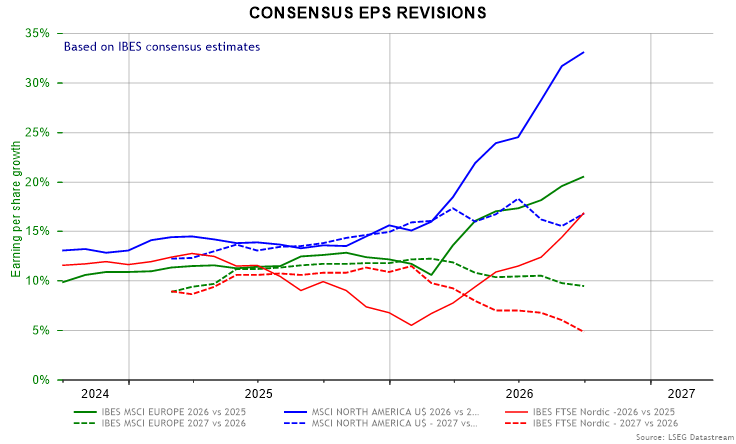
The second-quarter earnings season was particularly strong. Although analysts have revised next year’s forecasts lower, expected earnings growth of 12–15% remains robust by historical standards. A key risk is that revenue and earnings expectations linked to artificial intelligence ultimately prove too optimistic.
AI-related developments dominated the news flow in September. Attention focused on a new generation of applications, security breaches involving autonomous AI agents, and growing concerns over the cybersecurity implications of increasingly autonomous systems. These developments have intensified the global debate around regulation and safeguards. During the remainder of 2026, several prominent technology companies are expected to come to market, with investor attention particularly focused on large AI and infrastructure-related businesses.
Long-term interest rates rose sharply
The yield on the US 10-year rate moved above the 5% threshold, climbing 57 basis points to 5.33%. Germany’s 10-year rate rose by 30 basis points to 3.62%. The rise reflects strong nominal growth in the US, persistent inflation, growing sovereign borrowing needs, and higher risk premia. The Federal Reserve’s communication has taken on a more hawkish tone, prompting markets to significantly raise their interest rate expectations for the next 12 months. The European Central Bank is likewise expected to maintain a restrictive monetary policy stance.
High levels of public debt continue to raise concerns, particularly with regard to the fiscal positions of the United States and France. Within corporate bond markets, strong economic growth and earnings performance continue to support high-yield bonds. However, careful monitoring of interest rate, credit, and refinancing risks remains essential.
Figure: Changes in equity analysts’ consensus earnings forecasts for the current year and next year