Republicans set to lose the House and potentially the Senate
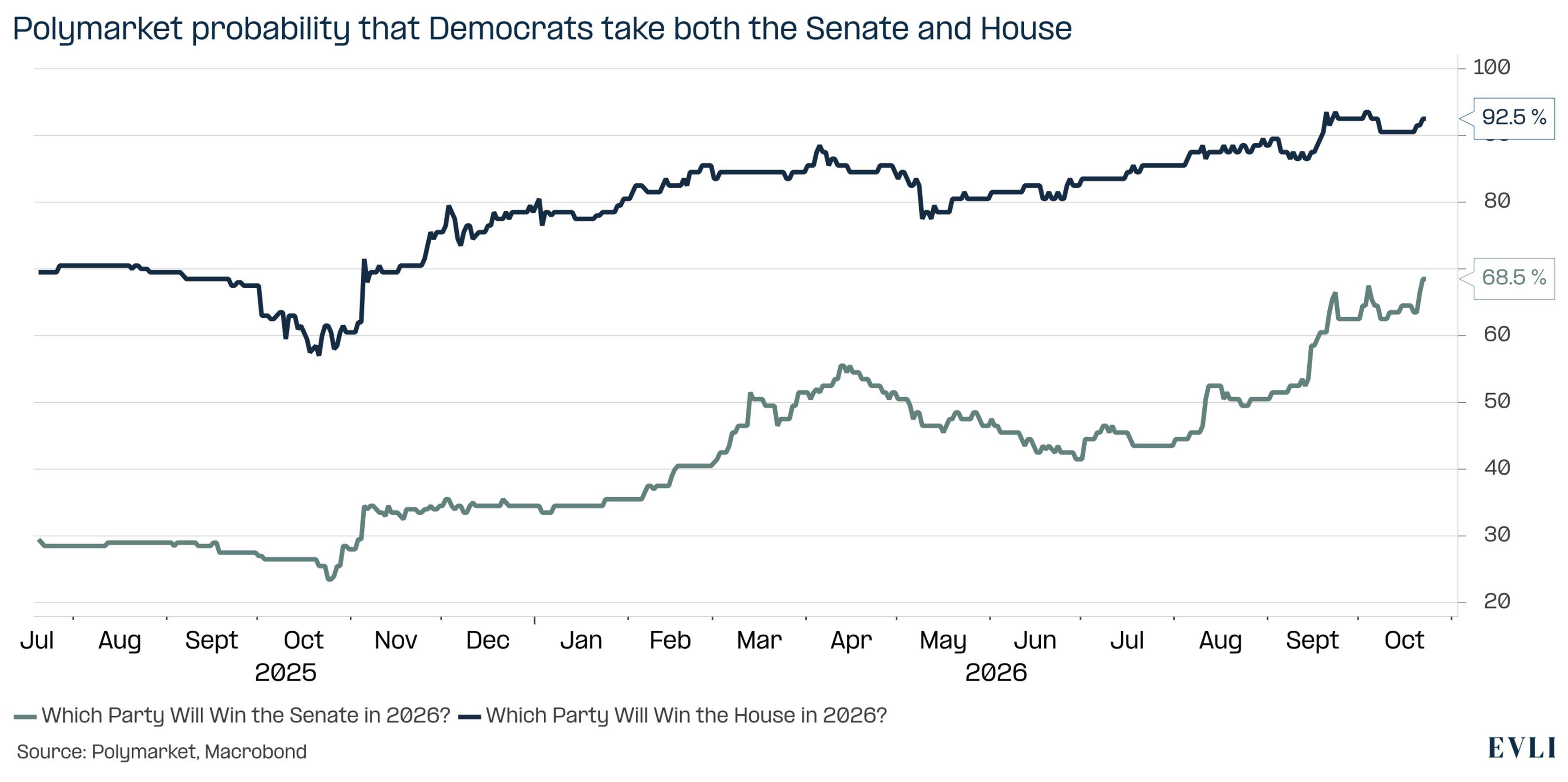
The US will hold midterm elections on November 3, which will likely see the Republicans lose control of the House of Representatives and possibly the Senate. The prediction market Polymarket has the probability of the Democrats winning the Senate at over 60 percent and the House at around 90 percent. Hence, whilst not a sure thing, the Democrats may win both houses of Congress.
The US economy has been robust, growing at an annualised rate of over two percent, but elevated inflation, particularly of gasoline, has taken a toll on the Republicans. The administration’s policies of imposing tariffs and embarking on war in the Middle East have contributed to inflation and affordability concerns, which are key voter issues. The war in Iran has presumably hurt the party over and above its inflationary impact as the war is deeply unpopular among most US voters.
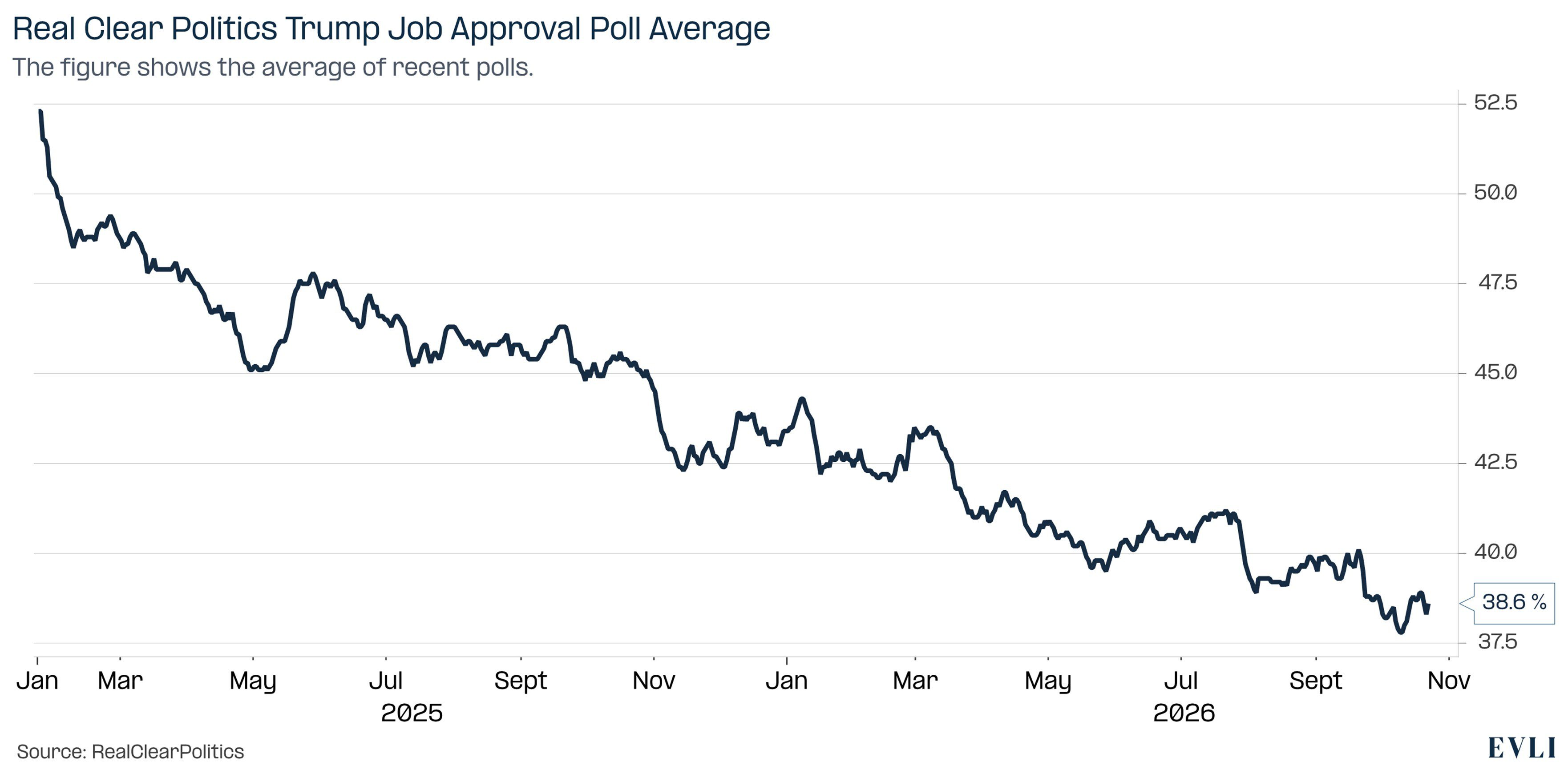
Midterms are also referendums on the president. President Donald Trump’s approval rating stood at 34 percent in a CNN poll conducted on October 15–18, among the lowest readings of either of his terms. The RealClearPolitics polling average stood at 38 percent.
Figure 1: Democrats are expected to take the House, and are slight favourites in the Senate.
The policy implications of losing the House and/or Senate
Republicans are almost certain to lose the House of Representatives, which means that the Trump administration will no longer be able to pass partisan fiscal legislation, and government funding will require bipartisan agreement. Instead, the administration will rely on executive powers, primarily in trade and foreign policy. The administration will still be able to make appointments such as Federal Reserve governors. If the Democrats seize the Senate, the administration’s nominees will face a contested confirmation process.
Losing the House of Representatives means that economic policy will in effect be gridlocked for the remainder of the Trump administration. For this reason, the administration has front-loaded economic policy with major tax cuts, or more precisely by extending tax cuts that were set to expire. This sequence also played out in the previous Trump administration, which started with major tax cuts, lost the midterms and then focused on foreign policy and appointments. The tax cuts that were legislated in the first Trump administration were then renewed in this Trump administration.
Figure 2: President Trump’s approval has fallen steadily throughout his second term.
The French connection
There is likely to be limited impact on stock and bond markets. Historically, markets are thought to be receptive because a split government means inaction which offers predictability and stability.
One could make the case that a gridlocked government would be a bad thing. After all, the US is running budget deficits amounting to six percent of gross domestic product (GDP) whilst gross federal debt stands at close to 130 percent of GDP.
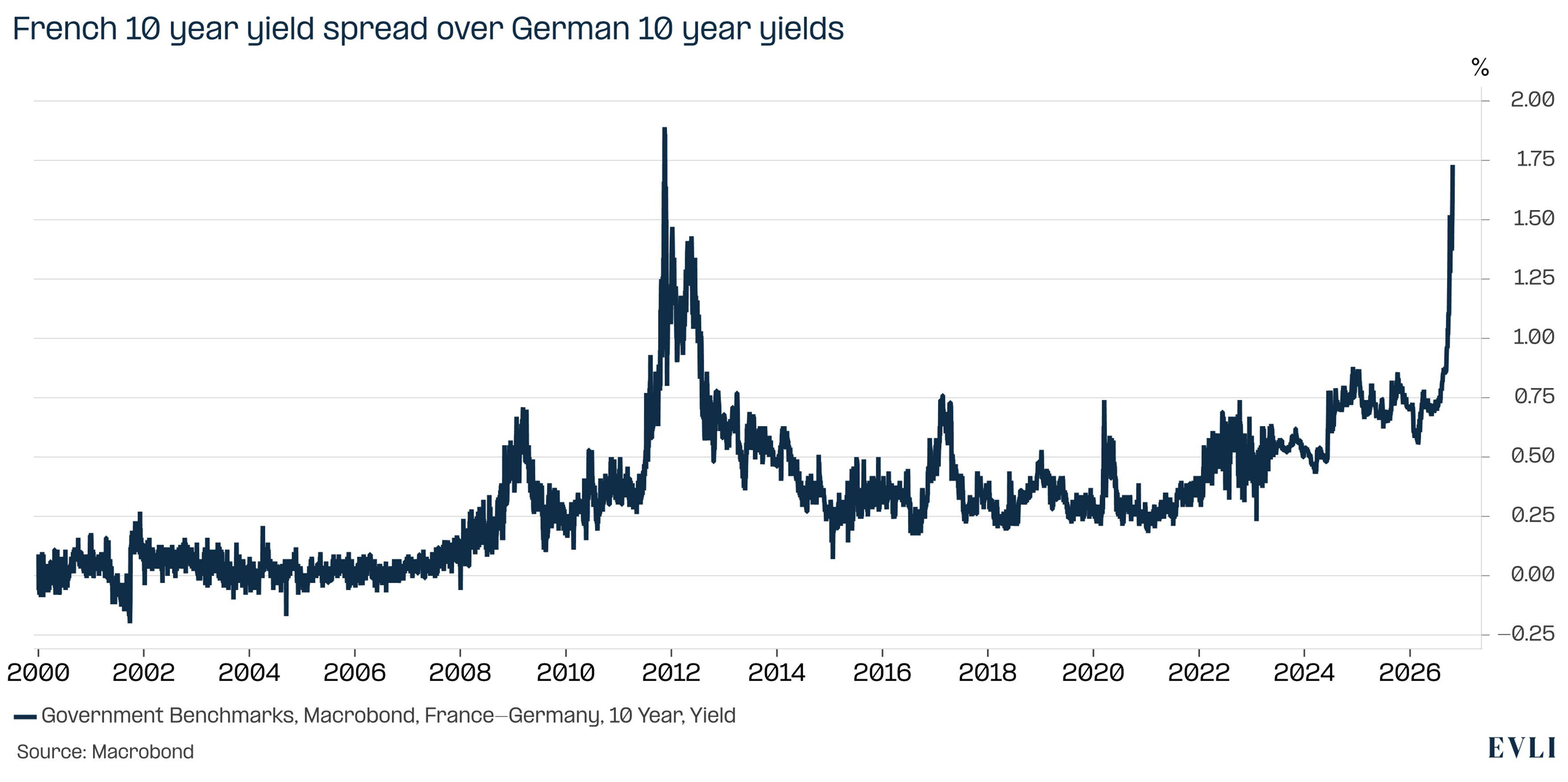
Indeed, this is precisely the case with France, which is running a budget deficit of around five percent of GDP and has a public debt-to-GDP ratio of close to 120 percent. The spread between French and German ten-year yields, a measure of the French risk premium, has widened by around 0.7 percentage points since the end of August to around 1.5 percentage points, the widest since the euro crisis. The market is concerned that the French political system will be unable to rein in the budget deficit, and that this may be the case regardless of who wins the elections. A similar prediction could be made about the United States, but the bond market seems relatively unconcerned: at around five percent, US ten-year yields are broadly in line with nominal GDP growth.
Different economies clearly have different debt thresholds from a market perspective. The US is able to run a more profligate budget than perhaps any other country. This, however, does not mean there is no threshold.
Figure 3: The French ten-year spread over Germany is the widest since the euro crisis.