The market environment is characterized by a strong, yet somewhat divided, economic outlook. Purchasing Managers’ Indices (PMIs) have delivered encouraging signals in recent weeks in both the euro area and the United States. The euro area composite PMI rose to a nine-month high, while its U.S. counterpart reached a four-year high. This supports the view that an immediate recession is not the central scenario.
At the same time, U.S. labour market data came in weaker than expected, easing concerns that monetary policy may need to be tightened in the near term. However, risks related to inflation, oil prices and geopolitical uncertainty remain. Sharp moves in oil prices, uncertainty surrounding Iran, and trade tensions between the United States and Canada have periodically weighed on risk appetite.
A broader acceleration in economic growth would still require a recovery in investment activity, particularly in the industrial sector, as momentum outside AI-related investment spending appears more subdued.
Strong corporate earnings continue to support equity markets
The outlook for equity markets remains cautiously positive. Key supporting factors include strong earnings growth, the ongoing investment boom in AI infrastructure, and more attractive valuations in certain segments following the market correction in July. In euro terms, the MSCI World Index rose 2.2% in August.
Corporate earnings growth has been exceptionally strong worldwide, and it is not limited to just the largest U.S. technology companies. Earnings trends have also remained favourable in Europe, Japan and emerging markets. At the same time, investor sentiment has heated up in certain areas, increasing the risk of a short-term market correction.
The artificial intelligence theme continues to offer compelling opportunities, although security selection remains critical. The rise of Chinese AI and semiconductor companies is intensifying competition, potentially putting pressure on pricing and challenging the profitability of closed-model ecosystems. Upcoming mega-cap IPOs (initial public offerings) are viewed with caution, as historically valuations have often been high at the time of listing.
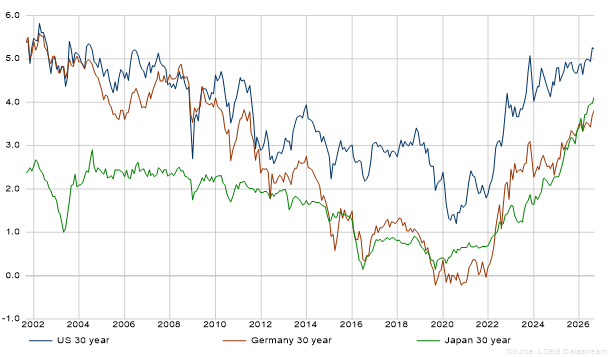
Long-term interest rates continue to rise
In the United States, the 30-year interest rate has been close to its highest levels since 2007, while long-term interest rates in Germany and Japan have also risen significantly. Germany’s 10-year interest rate continued to rise by 0.12 percentage points and ended the month at 3.32%. This marks the highest level of the year and the highest level in 15 years. In the United States, long-term interest rates were more volatile during August.
The rise in real interest rate to above 2% represents a meaningful headwind for the economy, tightening financial conditions for both households and businesses. Higher long-term interest rates remain one of the key constraints on both economic activity and financial markets.
The increase in long-term interest rates reflects investor concerns about long-term inflation, government financing needs and the substantial capital requirements associated with areas such as AI-related investment. The U.S. Treasury’s buyback programme for long-term government bonds helped stabilise markets temporarily.
Comments delivered by Fed’s new chairman, Kevin Warsh, at the Jackson Hole symposium were considered as hawkish. Warsh has established a working group to review the implementation of monetary policy, a move that is expected to reduce the predictability of future monetary policy decisions. Markets expect the Federal Reserve to raise its key interest rate at its next meeting on September 17.
Returns from fixed-income investments have been modest: government bonds have suffered from rising interest rates, while corporate bonds have performed relatively better.
Figure: Long-term interest rates have risen to their highest levels in decades