
Chinese AI models are threatening western leading-edge models according to model benchmarks and OpenRouter data. At the same time, Anthropic and OpenAI are preparing to list on the stock market. What does Chinese competition in AI models mean for the economy and for markets?
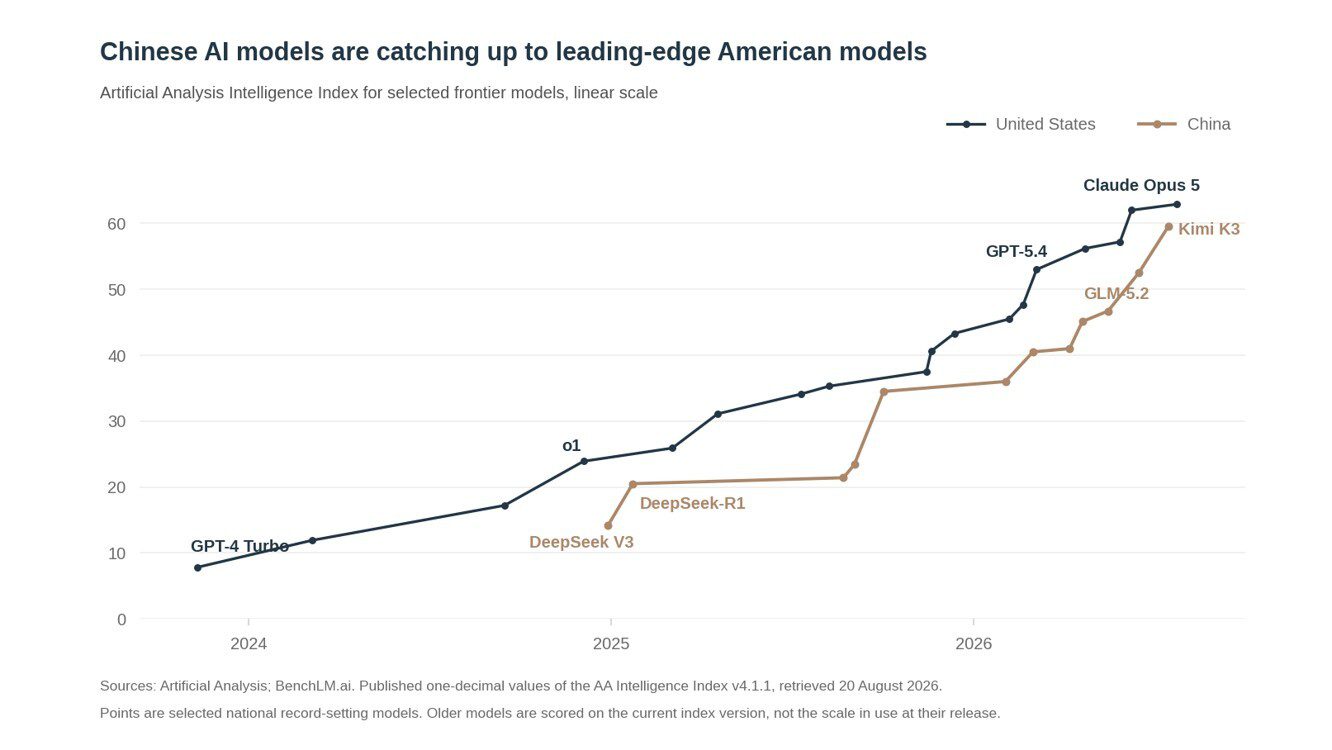
In June Anthropic released an AI model called Mythos that was considered so powerful that the model was temporarily withdrawn from use. However, a mere month later, a small Chinese AI lab called Moonshot AI released a model called Kimi K3 that, according to widely followed model benchmarks, turned out to be almost as effective. Moonshot released the model for all to use and modify. In reality we witnessed a sequel. Last year in January another Chinese lab, DeepSeek, shocked the world by releasing a model that was on par with OpenAI’s model.
Use of AI models has proliferated much faster than previous technologies such as the internet. Competitive pressure is forcing firms on the leading edge to release new model versions at an increasingly rapid pace. Non-leading-edge models continue to take a greater share of the global compute market, and advanced models are pushed further and further into the frontier. In truth, this is always the case with respect to technology, with computers, phones, games and imaging becoming more and more advanced. What is different with respect to AI is the pace, which is by most measures faster than any technology before.
The leading or bleeding-edge AI companies, Anthropic and OpenAI, both intend to list on the stock market. According to the Wall Street Journal, Anthropic may go public in September or October, and its market capitalisation could exceed that of SpaceX. The success of Chinese AI models has cast a shadow over both companies.
Can Anthropic and OpenAI hold on to their technological lead? And how viable is a business model whereby you are continually forced to release more powerful models only for them to be copied by competitors with no patent protection? Will the artificial intelligence industry evolve along the lines of the automobile industry? Chinese automobile exports have increased from roughly half a million to over nine million automobiles a year in the span of roughly six years, overtaking the combined automobile exports of Germany and Japan.
Figure 1: Chinese open models have caught up with American closed models according to model benchmarks.
The use of Chinese models has grown rapidly
Chinese models are causing a stir. Several Chinese model companies such as Moonshot AI, Zhipu AI, DeepSeek, Alibaba and MiniMax feature at the top of the leaderboard. In contrast to most US models, Chinese models also publish their key model parameters for anyone to modify. The Chinese models distil or run American models and use their model output to train their own models, thus bypassing most of the model development costs.
The Financial Times and Bloomberg have both reported that Chinese models have taken market share. For example, citing data from the OpenRouter site, Bloomberg reported that the market share of Chinese AI models rose from around 20 percent in June last year to 48 percent by the end of June 2026.
Show me the money
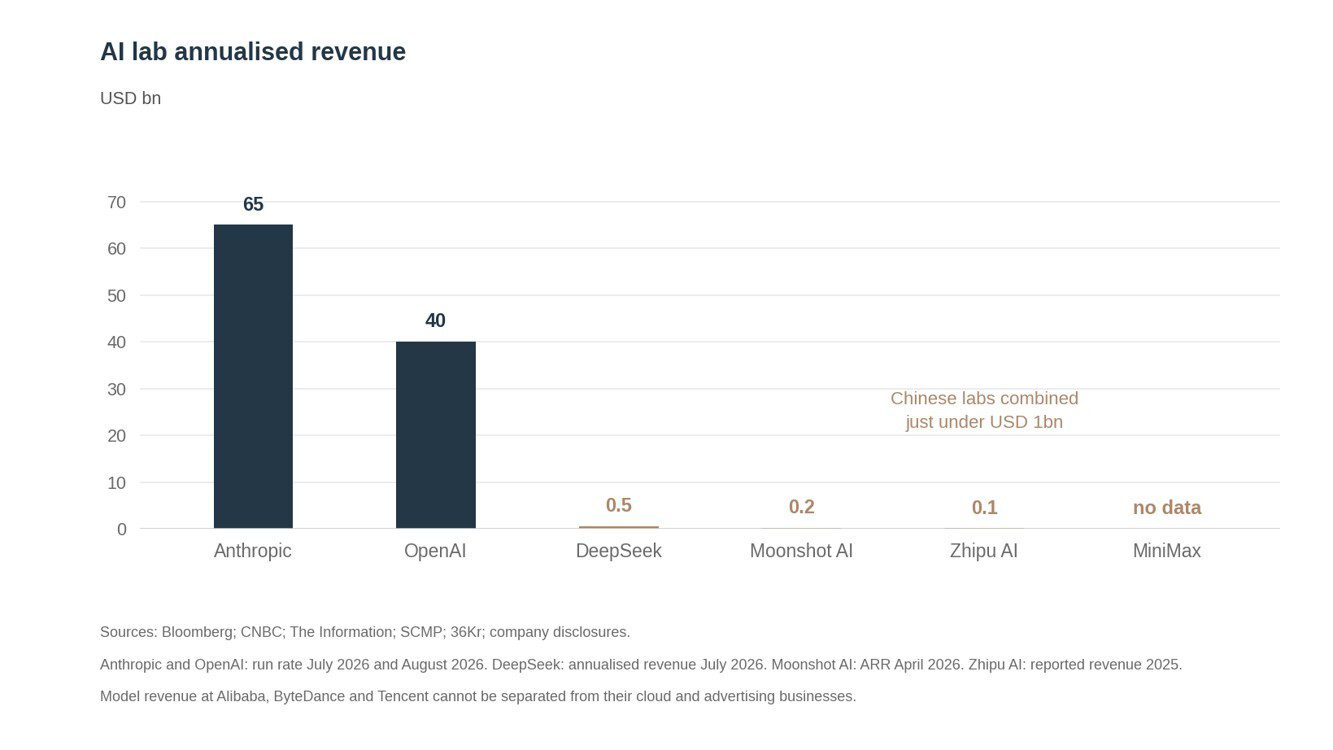
Chinese success is evident in benchmarks and in OpenRouter data, but revenue statistics tell a different story. According to Bloomberg in July, Anthropic’s annualised revenue — July’s revenue multiplied by twelve — stood at 65 billion dollars. It also reported that OpenAI’s annualised revenue stood at 40 billion dollars in August. The revenues of the Chinese AI companies DeepSeek, Moonshot AI and Zhipu AI are, according to company disclosures and the Hong Kong-based SCMP, only in the order of a billion dollars.
If Chinese AI companies are releasing top-tier models and grabbing market share, how is their annual revenue on the order of one percent of what the leading American model companies earn?
The inconsistency is simply due to the fact that Chinese models are inexpensive. Despite high volumes and winning accolades, fierce competition drives model margins down. Low pricing is not an irrational strategy, because many of the Chinese players have other businesses that benefit from having their own models. Alibaba, ByteDance, Tencent and Baidu can develop cheap models partly because the models increase the attractiveness of their cloud and application services.
It is also important to understand that Chinese models score well in benchmarks partly because their developers may take these benchmarks into account during model design. Benchmarks may also be poor proxies of real-world enterprise use cases.
Lastly, AI models, like semiconductors, sit at the heart of the great-power struggle between the United States and China. A model’s success is also a matter of national pride. The situation is not so different from the Cold War, when space programmes carried considerable propaganda value. At least the motivation was not sending data centres into space.
Anthropic and OpenAI are growing rapidly
Anthropic and OpenAI are profitable before accounting for model training. Model training is very expensive and requires financing over and above model revenues and hence both companies are free cash flow negative. Losses and cash burn are deliberate, because they are trying to grow as quickly as possible, which requires training new models continuously.
The AI labs are following the traditional Silicon Valley playbook, in which revenue growth is the sole priority for as long as rapid growth is a possibility. Corporate focus turns to profitability once growth begins to fade. This strategy is dynamically rational. Having grown, the companies can enjoy economies of scale and the industry usually consolidates into an oligopoly, leaving those left standing with higher profit margins. Effectively all technology companies follow the same growth-first strategy.
A leading semiconductor research firm, SemiAnalysis, published its own financial estimates of Anthropic and OpenAI over the summer. It estimates that Anthropic’s gross margin before the cost of training new models is between 60 and 65 percent. The gross margin on Anthropic’s usage-based enterprise sales may be above 80 percent. These are very high margins; Microsoft’s gross margin, for comparison, is a little under 70 percent. The gross margin on OpenAI’s enterprise business may be in the same range, but overall margins are dragged down by the consumer business. However, OpenAI appears to be catching up with Anthropic on the enterprise side.
In theory, as Anthropic’s revenue grows, proportionally less goes into training, and the profitability of the whole business should approach current gross margins. In practice the industry and the technology are in a state of flux, making all educated guessing exactly that.
Figure 2: Chinese AI companies’ revenue is dwarfed by Anthropic and OpenAI.
Artificial intelligence models are splitting into a commoditised and a premium layer
The AI market has split into two segments, leading-edge models and the rest. As AI models improve, inexpensive models take on ever more advanced tasks. Advanced models are increasingly reserved for the most difficult tasks or tasks that demand extreme caution. The extreme competition amongst non-leading models means that model makers are unable to make economic profits. The advanced segment, by contrast, currently consists of a profitable duopoly, at least before accounting for training costs.
The businesses of Anthropic and OpenAI, which dominate frontier models, are highly profitable before model development and account for a large amount of AI revenue. Bloomberg estimates that OpenAI accounts for more than half, possibly around 70 percent, of Microsoft’s AI revenues. Alphabet’s and Amazon’s AI businesses lean heavily both on Anthropic’s purchases of compute and on selling Anthropic’s models through their own clouds.
Alphabet has fallen behind in leading models after possibly choosing the wrong model strategy, and the company is rebuilding its AI unit. Given its heritage and the enormous resources at its disposal, it may very well be a contender in leading models if it chooses to devote sufficient resources. Its Google Cloud and TPU business is however very profitable and is model agnostic.
Meta and SpaceX have founders who want to operate at the frontier but are currently playing catch-up. Microsoft has taken a different route and aims to use proprietary models as a complement to its own suite of products rather than tackle leading-edge models head on.
Anthropic and OpenAI may choose to integrate vertically
If Anthropic and OpenAI can keep growing at the current pace and maintain their earnings profile, their next logical step could entail vertical integration. OpenAI has already unveiled its own custom accelerator chip, Jalapeño, designed with Broadcom. SemiAnalysis makes the case that the chip is as good as Nvidia’s newest, Rubin. This alone, if true at scale, would be quite astonishing. At the very least it is a sign of what may come in the near future.
In the near future Anthropic and OpenAI will also build their own data centres, possibly running their own bespoke chips. Vertically integrated, they could challenge the present hyperscalers and chip companies: Nvidia, Microsoft, Google and Amazon.
At the moment Anthropic and OpenAI look to be pulling away from the rest, but the AI market changes quickly. Just a few months ago Google was crowned as the king of AI. The question of who extracts most value, models or the wrapper encapsulating models, is still very much an open question.
The wrapper companies, such as the hyperscalers and software companies, have built distribution channels and may prove sticky. Enterprise customers have already moved their databases into the clouds of Amazon, Alphabet and Microsoft. It seems only logical that AI will reside next to databases as Amazon CEO Andy Jassy points out. In addition, wrapper companies can embed open-source models that charge little margin.
Andy Jassy also noted on the earnings call that data centres are an excellent business. He noted that the chips in an AWS data centre are replaced every five years. A chip pays for itself in a little under three years, meaning Amazon has two years to earn profits on these chips before replacing them. The data centre itself lasts 25 to 30 years, so Amazon can replace the chips five or six times over. The same logic naturally applies to Microsoft and Alphabet, though both also want to sell services beyond the cloud.
What’s at stake
Anthropic’s founders originally worked at OpenAI. A power struggle and an ideological schism led to an exodus in what became Anthropic. Anthropic currently holds a structural advantage, because it has focused on enterprise which has turned out to be far more lucrative than consumers. Advertising is likely the key for OpenAI to unlock its consumer business, but even then, it may not match the profitability of the enterprise segment. Anthropic is also likely to list on the stock market first and hence raise equity capital first.
The artificial intelligence ecosystem is a three-part vertical with semiconductor companies producing chips at the bottom, hyperscalers assembling these chips into data centres and selling compute in the middle and on top an application layer enabling the entire construct. Much of the construct is fed by the model companies that reside in the application layer, which is why it is so important.
This three-part artificial intelligence engine is in turn powering stock markets and the investment boom in the real economy. At the core of this engine is the artificial intelligence model. How much productivity will this technology yield and hence how much economic value will be generated? And shaping these models are two leading-edge model makers, Anthropic and OpenAI. And giving chase, US and Chinese technology giants, and a slew of Chinese AI labs.


